
2026/11/18
Modeling Human Collectives as Fluids
Dirk Helbing's Videos and Simulations
Traffic Dynamics in Urban Road Networks and Simulation of Multi-lane traffic. A video with stop-and.go dynamics
Mexican Wave
Simulate Escape Panic. Crowd Turbulence
Pedestrian dynamics: Spontaneous lane formation, congestion and patterns in a simple model for interacting pedestrians
Labels: #collectiveBehavior, #Modeling


2026/11/11
Long-range Collective Quantum Coherence in Tryptophan Mega-Networks of Biological Architectures
"An empirical-based study has found significant photophysical and photochemical effects in mega-networks of tryptophan in biological architectures resulting from quantum optical enhancement during collective coherence, long-range resonance and synchronization. Contrary to what used to be the common sentiment among experts that the biological system was too wet, noisy, and warm for non-trivial quantum effects like collective coherence, the observed superradiance and long-range interactivity even in the ambient thermal environment of the cell disprove such naïve perspectives (naïve because they were not taking into full account the unique structural / geometric organizational properties of cellular proteins and were based on very simplistic purviews of cellular organization), and is now one of many such findings that demonstrate the robustness of non-trivial quantum effects in the biological system. The findings have wide-ranging implications and are important because collective quantum optical effects in tryptophan mega-networks may underlie key cellular orchestration and signaling processes, like potentially ultrafast information transfer in neuronal axons, which have highly ordered core microtubule filamentary bundles." Full discussion by William Brown. Also news articles at EurekaAlert and PopularMechanics.
See relevant research at:
Babcock NS, Montes-Cabrera G, Oberhofer KE, Chergui M, Celardo GL, Kurian P. [2024] "Ultraviolet Superradiance from Mega-Networks of Tryptophan in Biological Architectures". J Phys Chem B. 128(17):4035-4046. doi: 10.1021/acs.jpcb.3c07936. PMID: 38641327; PMCID: PMC11075083.
Philip Kurian [2025]. "Computational capacity of life in relation to the universe".Sci. Adv.11,eadt4623(2025).DOI:10.1126/sciadv.adt4623
Labels: #Biology, #Computation
2026/11/05
Prediction misses the point of von Foerster’s “doomsday” equation
Birchenall’s [2026] reflection just published, recovers the modeling innovation of von Foerster’s oft forgotten paper, together with its prediction successes and ultimate failure. However, it misses the tongue-in-cheek nature of that 1960 paper by the brilliant cybernetician (he was co-editor of the transactions of the original Macy Foundation Cybernetics meetings). It is clear from its discussion section that von Foerster did not believe the “doomsday” would be upon us in 2026. Rather, he suggests that social, biological, or ecological limits would develop a cybernetic “people-stat” to keep population under bounds. Indeed, given his interest in “self-organizing systems” (he participated in a symposium on this topic in 1959 in Chicago and organized another one at the University of Illinois in 1962), his larger point was that in the presence of true complex systems, induction from past data will fail to predict the future due to adaptive and self-regulating mechanisms---a cybernetic argument dear to Von Foerster’s second-order cybernetics [Rocha, 1996].
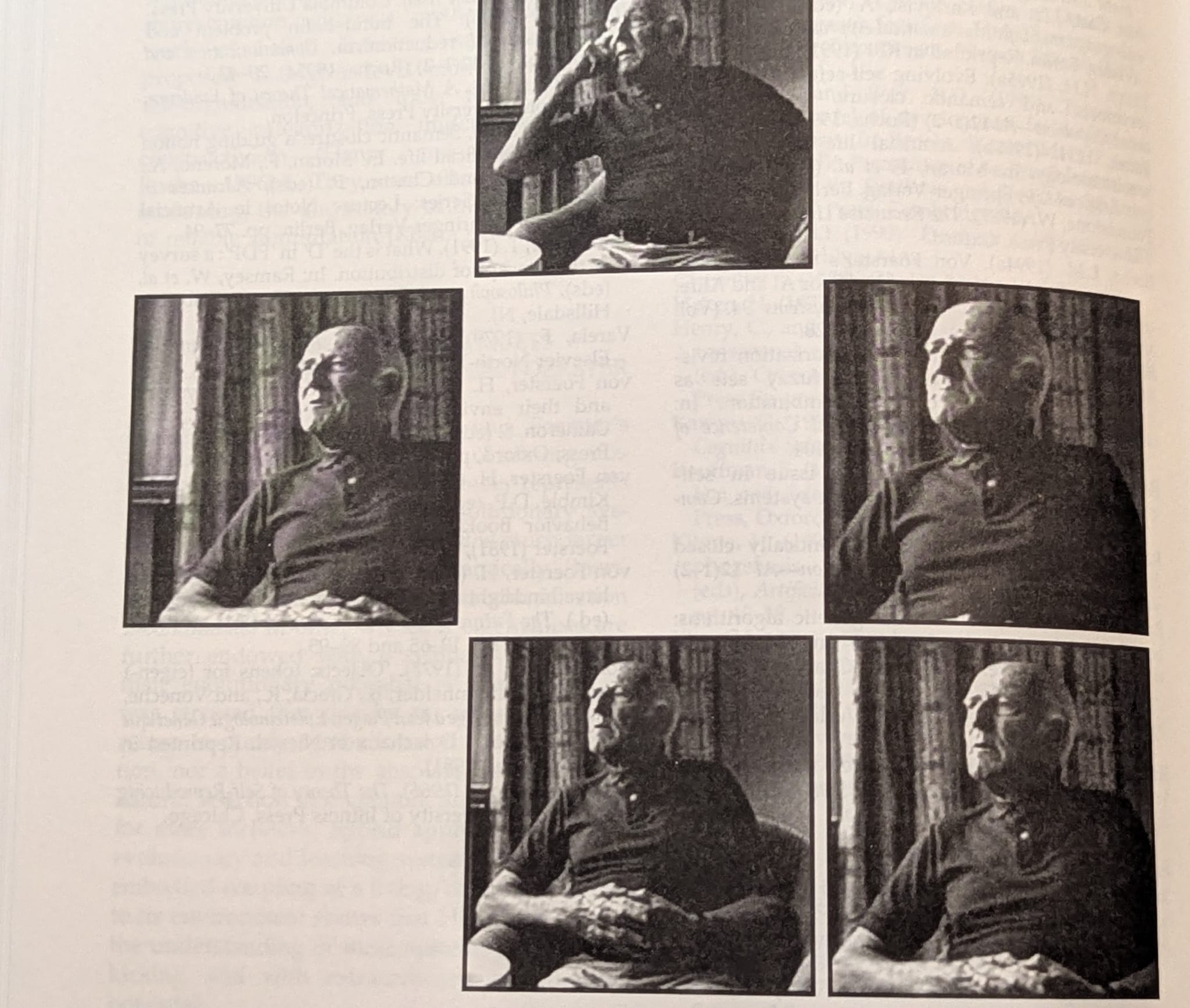
Let me add that I had the pleasure of discussing this paper with him to understand what the point of his power-law model of hyperbolic growth was. His goal was a tongue-in-cheek way of both emphasizing the hopelessness of a stationary model and that humanity should do something about population growth rather than wait for planetary finite resources to impose a “people-stat”.
On a even more personal note, Heinz von Foerster was a very supportive influence in my early career, via generous time-consuming conversations, and by writing letters for my admission to graduate school and to obtain a scholarship for my PhD.
Labels: #ComplexSystems, #Cybernetics, #Modeling
