
2026/08/27
From Bones to Turing Machines
The Lebombo Bone and Other Ancient Mathematical Objects
African Binary code
Turing Machine Simulator
Turing Machine Simulator 2
Turing Machine Simulator 3 (Java)
Some resources about the Abacus
The Abacus in Various Number Systems
Demo (The Chinese Abacus)
Mechanical Calculators
The Pascaline
The Antikythera Mechanism
The Antikythera Mechanism
NOVA: Ancient Computer
Babbage, Lovelace and the Analytical Engine
The Difference Engine
The Analytical Engine
9 Neat Facts About the World's First Computer Programmer, Ada Lovelace
Ada Lovelace and the Analytical Engine
Helping Ada Lovelace with her Homework: Classroom Exercises from a Victorian Calculus Course
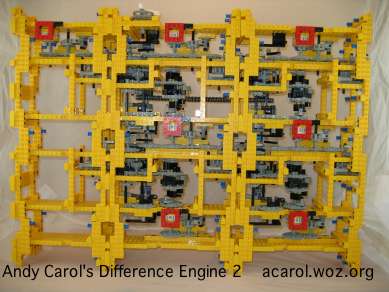
Cool implementation of Babbage's Difference Engine using LEGO! Photos, description of adder and carry propagation logic, mechanical issues, etc. at: By Andy Carol
Von Neumann's Computer Archicture
Von Neumann, J. (1945). “First draft of a report on the EDVAC". Moore School of Electrical Engineering, University of Pennsylvania. DOI: 10.5479/sil.538961.39088011475779.
John von Neumann and the “Report on the EDVAC” from An An Illustrated History of Computers.
Dyson, George. Turing's cathedral: the origins of the digital universe. Pantheon, 2012.
African Binary code
Turing Machine Simulator
Turing Machine Simulator 2
Turing Machine Simulator 3 (Java)
Some resources about the Abacus
The Abacus in Various Number Systems
Demo (The Chinese Abacus)
Mechanical Calculators
The Pascaline
The Antikythera Mechanism
NOVA: Ancient Computer
Babbage, Lovelace and the Analytical Engine
The Difference Engine
The Analytical Engine
9 Neat Facts About the World's First Computer Programmer, Ada Lovelace
Ada Lovelace and the Analytical Engine
Helping Ada Lovelace with her Homework: Classroom Exercises from a Victorian Calculus Course
Cool implementation of Babbage's Difference Engine using LEGO! Photos, description of adder and carry propagation logic, mechanical issues, etc. at: By Andy Carol
Von Neumann's Computer Archicture
Von Neumann, J. (1945). “First draft of a report on the EDVAC". Moore School of Electrical Engineering, University of Pennsylvania. DOI: 10.5479/sil.538961.39088011475779.
John von Neumann and the “Report on the EDVAC” from An An Illustrated History of Computers.
Dyson, George. Turing's cathedral: the origins of the digital universe. Pantheon, 2012.
Labels: #Computation, #Turing


2023/10/23
Neural-inspired NorthPole energy-efficient computing chip
"The amount of data humans process and send around the globe on a daily basis is astonishing. However, the energy cost involved is high, and there is a strong need for designing energy-efficient devices. Modha et al. describe a chip with a neural inspired architecture, called NorthPole, that achieves substantially higher performance, energy efficiency, and area efficiency compared with other comparable architectures (see the Perspective by Iyer and Roychowdhury). A key feature of this chip is the recognition that for almost all kinds of computing, access to memory plays as important a role as logic processing. Unlike analog in-memory computing, this purely digital system has the option of tailoring the bit precision as needed, which allows for optimization of the power usage". Full Article @ Science.

Labels: #Computation
2020/12/11
molecular collectives that regulate genes
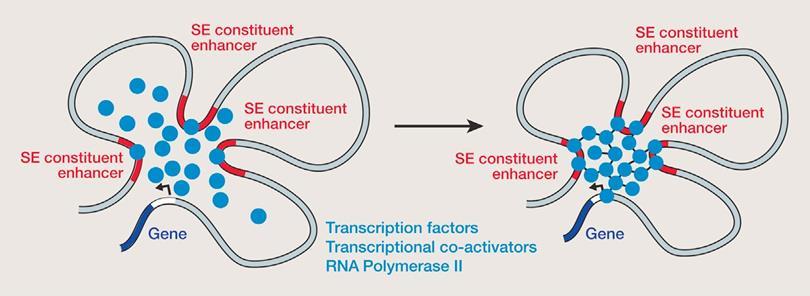
Cells use condensed ‘blobs’ to collect the molecules involved in regulating genes, sort of "network fluids with viscoelastic properties". Opens very interesting theoretical possibilities for stochastic information processing in eukaryotes. Full article @ chemistryworld.com.
Labels: #Biology, #Computation, #life
2019/04/11
CRISPR Computer in Human Cells
A CRISPR/Cas9-based core processor that enables different sets of user-defined guide RNA inputs to program a single transcriptional regulator (dCas9-KRAB) to perform a wide range of bitwise computations, from simple Boolean logic gates to arithmetic operations such as the half adder. [...] In principle, human cells integrating multiple orthogonal CRISPR/Cas9-based core processors could offer enormous computational capacity. Full article @ PNAS

Labels: #Computation, #TuringTape
2015/12/01
Ada ovelace: Enchantress of abstraction
"The bicentenary of Augusta Ada King, Countess of Lovelace, heralds the critical reassessment of a remarkable figure in the history of Victorian science. Ada Lovelace (as she is now known) was 27 years old and married with 3 children when she published the first account of a prototype computer and its possible applications in 1843. Her 20,000-word paper was appended as seven Notes to a translation of a descriptive article, Sketch of the Analytical Engine Invented by Charles Babbage." Book review @ Nature : Nature

Labels: #Computation, #Computers
2015/09/10
Turing Machine Simulators
Turing Machine Simulator 1
Turing Machine Simulator 2
Turing Machine Simulator 3
Turing Machine Simulator 2
Turing Machine Simulator 3
Labels: #Computation, #Turing
